 (Rebekah Raleigh/P-D) |
I aced the test by utilizing the same strategy that worked for me in high school - cramming.
But it also helped that I was taught the material in school decades ago. And that I'm a native English speaker.
I had just passed what many immigrants refer to simply as "the test." For thousands of hopefuls, the exam prompts nightmares and knotty stomachs. But passing it, along with a background check, means getting a step closer to becoming a naturalized U.S. citizen.
For the record, I am a U.S. citizen. I immigrated to the country as a toddler and was naturalized when I was 7.
Last year, more than 390,000 immigrants filed applications to become Americans. Becoming a citizen is a somewhat arduous process. First, applicants need to cough up $330 for the application fee, plus an additional $70 to be fingerprinted.
Then they must meet a few criteria.
They need be at least 18 (with exceptions for some applicants who are younger), have lived in the country for five years (three if they are married to a U.S. citizen); be of good moral character (any aggravated felony permanently bars you from the process); and, unless you're elderly or disabled, you must speak and understand English - at least enough to pass the test.
This highly revered, sometimes dreaded exam is a basic quiz on U.S. history and government. But the test comes at the end of a lengthy application process.
Most applicants will fill out a form called the N-400. (This actually is a possible test question, folks.) It has six pages of instructions for 10 pages of questions ranging from a detailed account of your marital history to trips you've made outside the country. It also asks about incidents that may cast doubt on your good moral character. For instance, have you ever been a habitual drunkard? Been a prostitute, or solicited anyone for prostitution? Been married to more than one person at the same time?
The questionnaire asks about affiliations you may have had. Jill Schreiner, a district adjudications officer for U.S. Citizenship and Immigration Services, said some people admit having been members of the communist party. But, in her 10 years of administering the test, she has never had anyone check the "yes" box asking if they have ever belonged to a terrorist cell.
So when Schreiner went over the N-400 with me, she used a sample form. Had I truly been applying for citizenship, she would have gone over every one of the applicant's answers. It's one way she can assess a person's English proficiency.
"If you cannot understand well enough to get through that application or at least show me that you're understanding, then we just won't even do the test," she said.
Ah, the test. Officially, there is no standard exam. Applicants typically are asked 10 questions - sometimes a few more, sometimes a few less. The set is randomly generated by computer, and six out of 10 correct answers is considered passing.
To prepare, the U.S. Citizenship and Immigration Services provides a list of 100 sample questions on its Web site, www.uscis.gov.
Some of the questions are on the too easy side, such as: What are the colors of the flag?
But then there are those that even longtime Americans may not be able to answer, such as, How many amendments are there to the Constitution? (27) or, How many voting members are in the House of Representatives? (435). And can anyone really name the 13 original states? Hint: Vermont is not one of them, but Georgia is.
Some questions are reflective and seemingly open-ended, such as: Name one benefit to being a citizen of the United States. The listed answer is, "To obtain federal government jobs, to travel with a U.S. passport, or to petition for close relatives to come to the United States to live."
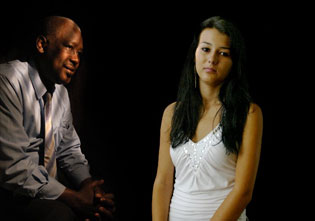
Those aren't necessarily what comes to mind for most Americans, but traveling with a U.S. passport definitely ranks high for Mirela Jazvin of Mehlville. The 18-year-old Affton High School graduate came to the St. Louis area in 1998 with her refugee parents. She said she's looking forward to flashing a U.S. passport and breezing through airport lines the next time she travels to her native Bosnia - or anywhere abroad.
On Friday, she became the first person in her family to become a U.S. citizen.
"I'm really, really happy. This is an unbelievable experience," she said after her swearing-in ceremony at the Old Courthouse.
On the Fourth of July weekend, about 60 other immigrants became citizens in the ceremony at the Courthouse rotunda, decorated with red, white and blue banners and an abundance of American flags. Some dressed for the occasion, wearing business suits or sequined dresses, while others were more casual, pairing T-shirts with jeans and flip-flops.
Jazvin, an only child, came to the ceremony alone. She said both of her parents work and couldn't afford to take the time off. But they were planning a party for her on Saturday.
Jazvin thought the naturalization exam she took last October was fairly easy, but she admitted studying hard for it and knowing most of the answers from her history class at school.
Schreiner said some people get so nervous during their interview they have trouble answering questions correctly, even though they obviously are prepared.
"If you ask them, 'What is Congress?', they'll tell you what is the Constitution. They just hear 'con,' and obviously they did memorize the answers," she said.
But sometimes, applicants don't even make it that far. Schreiner said some people have trouble from the moment they walk in and are asked to repeat an oath to answer all questions truthfully. When they struggle with even that, Schreiner stops right there. Anyone who fails the interview can try again three months later.
For those who pass, some will cry, Schreiner said. Many want to hug her. Others rush back into the waiting room, where friends, relatives or their English teachers await the results.
Sometimes, they tell her stories about how long they have waited for that moment.
Marie Desir has waited for a dozen years. She and her husband moved here from Haiti with two children. The St. Charles couple have since had three more.
At Friday's naturalization ceremony, Desir raised her right hand as she repeated the oath of citizenship. She then turned around and beamed at her husband. The couple first applied for citizenship in 2004. Desir's husband was sworn in earlier this year - an applicant is not officially a citizen until he or she is sworn in.
But Marie Desir, 43, said her applications had a few problems, although she's not sure what they were. She took her exam in May and proudly accepted her certificate of citizenship on Friday.
"I was so happy. I waited for that moment for a long time," she said.
Then Desir walked into a nearby room where representatives from the League of Women Voters were registering people to vote.